
Key Takeaways
- UV-C light between 200 and 280 nm is a well-established HVAC germicidal weapon that deactivates bacteria, viruses, and mold by disrupting their DNA. Therefore, utilize it as one component in a multi-pronged air quality approach instead of a standalone measure.
- Proper placement near evaporator coils or in return ducts and sufficient exposure time and intensity are essential for effectiveness. Evaluate airflow patterns and avoid shadowed areas before installation.
- Pair UV-C with filters, ventilation, and humidity control to combat non-biological pollutants such as dust, VOCs, and smoke that UV-C cannot eliminate.
- Anticipate maintenance such as bulb replacement every 9 to 12 months, cleaning bulbs and fixtures, and monitoring a minor recurring expense for parts and professional service.
- Put safety first. Select ozone-free UV-C products, install shields or place units within sealed ductwork, and adhere to lockout and PPE protocols during maintenance to avoid skin and eye exposure.
- Think about candidate fit and installation path by deciding between climate, stubborn biological contamination, HVAC compatibility, and whether you’d like to do it yourself or have professional installation and warranties.
A UV light air purifier for HVAC is a germicidal device that uses ultraviolet-C light to cut down on microbes and mold within your ductwork and coils.
These systems help reduce allergens, control sources of odor and maintain cleaner coils for consistent airflow and improved energy efficiency.
Designs vary by lamp type, location and service requirements. The following sections contrast sizes, prices, installation processes and efficiency data to help inform decisions.
Understanding UV-C
Germicidal UV light, known as UV-C, is short-wavelength ultraviolet light in the 200–280 nm range used in HVAC systems. It’s a type of shortwave ultraviolet that’s absent at ground level because the atmosphere filters it out, thus man-made sources supply the required radiation. In HVAC work, UV-C is used not only to sterilize evaporator coils but to sanitize moving air, and it’s a documented method to reduce airborne microbes in conjunction with good filtration.
1. The Science
UV-C kills or inactivates microorganisms by damaging their DNA. UV-C is most germicidal at 253.7 nm, as DNA absorbs near this wavelength, creating lesions that prevent replication and trigger repair. Microbes are therefore unable to reproduce and they perish or become non-infective.
Effectiveness depends on three things: intensity of the lamp, how long the organism is exposed, and how close the emitter is. UV-C is one band in the ultraviolet spectrum. UVA and UVB exist at longer wavelengths and lack the same germicidal potency.
Far-UVC, around 222 nm, is a newer approach that in research seems to both inactivate microbes and be safer for human skin and eyes.
2. The Mechanism
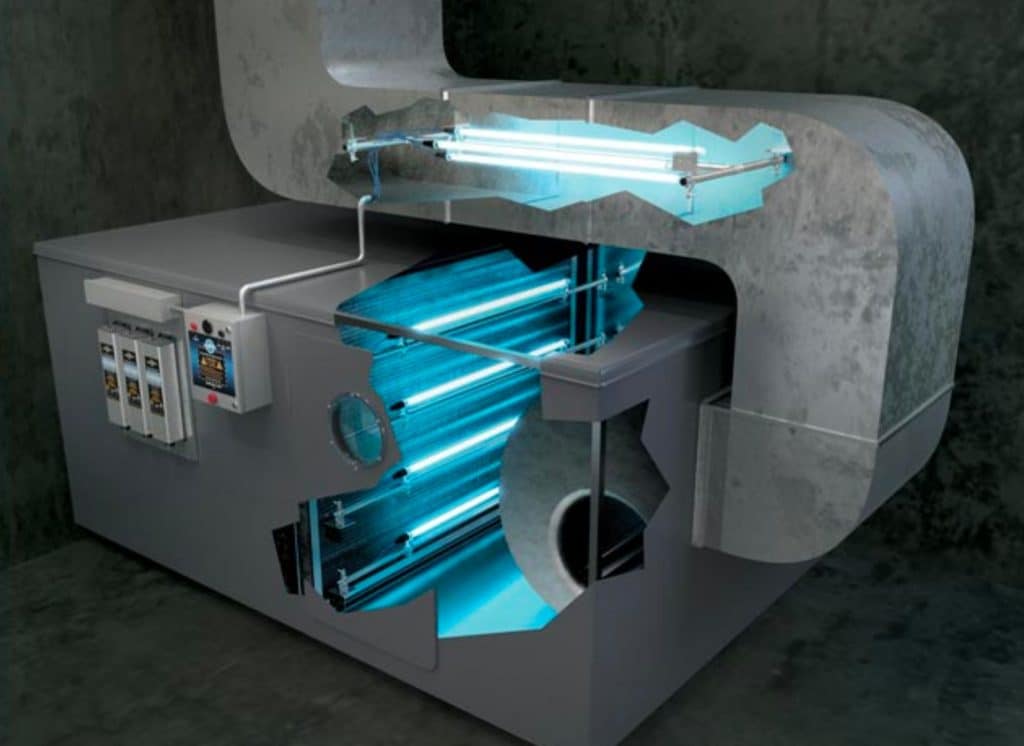
HVAC UV lights are typically installed close to evaporator coils or within ducts so air and surfaces flow through the irradiated field. Continuous operation is key because it cleans the air as it moves into the home while disinfecting the coil surfaces that become breeding grounds for mold and bacteria.
Every system I’ve seen marries UV-C emitters with mechanical filters. UV kills microbes that are viable, and the filters remove the particles. Proper placement matters. Shadows, blocked areas, or long distances cut intensity and reduce kill rates, so careful layout is required for real coverage.
3. The Types
These can take two main forms: coil-sanitizing lights targeted to evaporator coils and air-sanitizing lights installed in ductwork for whole-house treatment. Duct-mounted UV systems treat an entire HVAC circuit, while portable UV-C purifiers clean a single room.
Emitters are low-pressure mercury lamps, which are traditional and near 253.7 nm, and newer UVC LEDs and far-UVC sources, including 222 nm. LEDs are more power efficient but at this moment cost more per output. A quick comparison helps choose between coil versus duct, lamp versus LED, and whole-house versus local units.
4. The Placement
Install close to coils or in return air ducts to maximize exposure to contaminated surfaces and turbulent airflow. Don’t point it at plastic components or wire insulation, which deteriorate under UV and lead to maintenance expenses.
Locate units where air movement agitates particles into the irradiated stream to increase inactivation. Proper positioning enhances safety and efficacy, with electricity consumption and occasional bulb changes representing recurring costs.
Real-World Efficacy
UV-C light in HVAC systems has been researched to reduce mold, bacteria, and some viruses on coils, in ducts, and surfaces in the airstream. We have plenty of lab and field studies demonstrating significant decreases in microbial burden when UV-C is applied to germicidal intensities near 253.7 nm. Effect size is a function of dose, distance, and exposure time.
Far-UVC at 222 nm has recently emerged in longer trials as a potentially safer option for occupied spaces, with a 36-month study indicating acceptable safety over repeated use. UV systems for air and surface disinfection are in many buildings, but they don’t purport to prevent or cure disease.
Advantages
UV-C decreases microbial buildup on coils and inside ducts, assisting to maintain surfaces cleaner and reducing the risk of re-entrainment of spores and bacteria into the air. This aids indoor air quality and can make areas less hospitable to mold regrowth.
By keeping coils free of biofilm and organic build-up, HVAC systems can run closer to design efficiency, sometimes resulting in measurable energy savings and marginally lower compressor runtime. Users experience less mildew smell and decreased odors associated with microbial activity.
UV-C can degrade the molecules that cause odor or eliminate the bacteria that produce them. Maintenance goes from multiple deep coil cleanings to bulb checks and an occasional wipe-down, which most consider less onerous than repeated invasive cleaning. These gains are most powerful when UV-C is coupled with effective filtration and routine HVAC care.
Disadvantages
UV-C doesn’t clear away dust, lint or other large particulates, so HEPA filters are still needed to control the particulate load. In “fly-by” applications where air flows at a few hundred feet per minute in return ducts, exposure time may be too brief to effectively inactivate, so location and intensity become key.
UV-C can deteriorate certain plastics and materials. Fins, wiring insulation and polymer components can become brittle with extended exposure. Bulbs need replacing and cleaning. Output decreases with aging and surface fouling, and this adds constant replacement costs and labor.
Bad installation or lack of intensity, such as being too far from the target, wrong wavelength or low lamp output, may have no germicidal effect. Distance counts, as intensity falls with range. Testing finds varying live-virus outcomes at 6 inches and 82 inches.
Finally, the UV-C band is narrow. Two hundred to two hundred eighty nanometers is most effective, with two hundred fifty-three point seven nanometers close to DNA’s peak absorption. Far-UVC at two hundred twenty-two nanometers behaves differently and may be safer but requires specific validation per installation.
Beyond The Hype
UV-C can inhibit biological growth on coils and in ducts. It’s not a panacea for indoor air quality. Consider it one layer in a filtration, ventilation, and humidity control system. Expect limits. UV-C does not remove gases and many chemical pollutants. Real-world performance depends on HVAC design, bulb condition, and airflow.
A Critical Look
So UV-C will stop COVID-19 or all viruses, they say, overlooking real-world constraints. Lab studies demonstrate UV-C can inactivate much of viruses given the right exposure times and UV intensities, but HVAC ducts usually only expose air for seconds and from multiple directions. That makes it less efficient against certain airborne viruses in real world use.
Beyond The Hype UV-C does not treat non-biological contamination. VOCs, many gases, and smoke need sorbents or source control. Particles such as visible dust and some aerosols are most effectively treated by filters. High-efficiency media cleaners trap particles as small as roughly 1 µm, and aerosols vary from 0.001 to 100 µm, so filter selection is important.
Performance plummets when bulbs are caked, old, or the air flow is obstructed. UV-C intensity decreases with dust accumulation, so regular maintenance and lamp replacement are necessary. A few systems emit ozone. Folks with lung disease, such as bronchiectasis, can have a reaction to ozone and should not use ozone-generating equipment.
Common misconceptions and clarifications:
- UV-C kills all pathogens is false; certain mycobacteria and mold in ducting can resist or be shielded.
- UV-C replaces filters. No filters clear particles UV-C won’t.
- Any bulb works — No; wavelength, intensity, and placement matter.
- One device fixes indoor air pollution. This is not true; a multi-pronged approach is necessary!
- UV eliminates VOCs — False; sorbents or ventilation required.
The Right Candidate
Homes with stubborn mold or humid climates gain obvious benefit from coil and drain pan UV-C, where biological growth is a recurring concern. Allergy, asthma, and other respiratory sensitive households can use UV-C as an adjunct to high-efficiency filters to reduce bioaerosol loads.
Keep in mind that indoor air can be five times more polluted than outdoor air. Commercial settings — offices, healthcare facilities and schools — are good candidates, particularly where ventilation is poor and occupancy is dense. Over 30,000,000 school days are lost to allergy related illness, so layered air cleaning goes a long way.
Evaluate HVAC compatibility first. Check airflow patterns, coil access, and electrical capacity before installing UV-C.
The Wrong Candidate
Homes where the primary issues are dust, smoke, or chemical pollutants aren’t going to get a lot from UV-C on its own. Media air cleaners or activated carbon more effectively address those concerns. Older or poorly maintained HVAC systems might not deliver the steady air flow or lamp mounting required for UV exposure to be effective.
UV-C is not recommended where direct lamp exposure might damage materials or adjacent electronics. If a home is already well-ventilated or has low HVAC use, the cost of central UV-C from systems that range in price from small portables at approximately $20 to central hybrids that install in excess of $1,500 may not be worth it.
Installation Decisions
Selecting and placing a UV light air purifier for an HVAC system requires clear priorities: budget, system compatibility, and the air quality goals for the space. Installation costs vary from economical DIY kits all the way through to advanced central hybrid systems that can reach around 1,500. Compatibility covers duct layout, do panel-type filters sit on the return side, do you require coil sterilization or air sterilization.
Air quality objectives dictate whether you’re primarily trying to contain coil growth and preserve cooling efficiency, or additionally reduce airborne germs traveling through the return air stream.
DIY Route
DIY installation works for owners with fundamental electrical proficiency and calm mitts. Read the manufacturer instructions precisely, as many kits are geared for a convenient return-duct mount near a panel-type filter or grille. Others anticipate installation near the evaporator coil for coil sterilization.

DIY kits might work for tiny homes, but they do not have lamp intensity or coverage of professional-grade systems and may not offer the exposure time required for germicidal effect in “fly by” applications where air speed lowers UV dose. Improper wiring or loose mounts create two risks: system ineffectiveness and safety hazards.
UV-C exposure to skin or eyes is hazardous, and inadequate electrical connections increase fire risk. Utilize step-by-step instructions, LOTO for power, and PPE such as UV-blocking glasses and gloves when handling and servicing lamps.
Professional Help
A trained HVAC technician will measure system airflow, identify the evaporator coil if coil sterilization is targeted, and verify panel filter positioning on the return side. They will size lamps to the duct cross-section so exposure duration suits germicidal requirements.
Experts guarantee proper wiring, safe mounting, and interface the unit with existing controls, which minimizes the risk of shortened lamp life or less-than-stellar sterilization due to “fly by” conditions. Professional installation often comes with warranty and after-install support, and can take care of electrical work to code.
Labor costs increase the initial outlay but may decrease lifetime cost by positioning to minimize energy penalties. Don’t forget that electricity draw and periodic bulb replacement are continuing costs — incorporate them into lifecycle budgeting.
Keep the air filters right first — they take a lot of the load off before UV-C and influence system energy via pressure drop. The energy effect can be approximated with Power equals 0.001 times Q times R divided by the product of Em, Ed, and Eb.
Checklist for readiness: Confirm return-side filter location, determine coil versus air sterilization need, measure duct dimensions and airflow, assess homeowner electrical skills, estimate budget including labor and lifecycle costs, and plan for PPE and maintenance access.
System Maintenance
Regular maintenance is key to sustained germicidal efficiency and indoor air quality. The UV-C system in an HVAC system is pretty much a one thing deal. The lamp needs some love. Ignoring cleaning or bulb replacement will simply decrease UV output and the system’s ability to suppress microbial growth.
Pair UV checks with regular HVAC service visits for convenience and to allow technicians to examine coils, filters, and ductwork simultaneously. Maintain a service record to provide bulb longevity, cleaning schedule, warranty periods, and repairs.
Bulb Lifespan
With most UV-C bulbs dropping effective output after 9 to 12 months, manufacturers routinely suggest replacing them every year. Change bulbs on schedule to keep germicidal strength high and to prevent lamps from operating past their rated life, which consumes power while providing less air sterilization.
While you’re at it, record replacement dates on the unit or your digital calendar and remember the 90-day warranty against burnout for immediate concerns. Certain systems promote themselves as maintenance free, but that lamp swap every year is still necessary for year-round protection.
Cleaning Protocol
Disconnect power prior to any cleaning to prevent electrical shock and ultraviolet exposure. Wipe bulbs and fixtures with a clean, lint-free cloth every 3 to 6 months to dislodge dust and debris that block UV output.
Check around ductwork and coils at every cleaning. The UV light inhibits unwanted growth inside the air handler and ducts, and plenty of users experience cleaner coils and less dust accumulation in their units. Apply a gentle alcohol wipe for persistent grime, steer clear of scrapers, and record the clean-up in the maintenance log for posterity.
Ongoing Costs
Your ongoing expenses are bulb replacement, the occasional fixture cleaning, and a bit more electricity consumption. Bulb prices depend on brand and output. Labor is negligible if you replace lamps yourself but can add to the cost if a technician is employed.
Energy pull is typically small, yet the aggregate prices add up over years when you compare systems. The sample cost table below depicts the average annualized cost by bulb price and replacement rate.
| Brand / Model | Bulb Price (USD) | Replacements / Year | Estimated Annual Cost (USD) |
|---|---|---|---|
| Brand A — In-line | 30 | 1 | 30 |
| Brand B — Coil mount | 45 | 1 | 45 |
| Brand C — High-output | 60 | 1 | 60 |
| Brand D — Commercial | 80 | 1–2 | 80–160 |
Installation can be as quick as 15 minutes, so upfront work is minimal. Track costs in the same maintenance log where you enter dates and warranty notes to get an accurate sense of long-term value.
Safety Protocols
UV-C air purification in HVAC units cuts pathogens yet carries particular safety obligations. Shielding, air chemistry, maintenance, and design decisions all impact risk. These subsections tackle ozone risk and exposure concerns with actionable guidance, examples, and measurable practices to maintain systems both efficient and safe.
Ozone Risk
Some UV-C lamps generate ozone by generating short wavelengths that disintegrate oxygen molecules. Ozone is a lung irritant, and elevated indoor ozone levels can induce asthma attacks and exacerbate other respiratory illnesses. For instance, an older low pressure mercury lamp emitting less than 240 nanometers will create a measurable amount of ozone, while “ozone-free” lamps tend to cut off emission above that.
Choose UV products designed for HVAC and specifically rated ozone-free. Seek out manufacturer information that displays output spectra and third-party testing. If retrofit work employs legacy lamps, think about a swap to newer ozone-free bulbs or adding downstream catalytic ozone scrubbing.
In areas with sensitive populations, like clinics or schools, keep an eye on indoor ozone with an easy-to-use sensor. Readings above 0.05 ppm should be investigated and mitigated. Flexible ductwork near UV sources (within three feet) should be metal or rated for UV because the rays can destroy the plastic or mesh coverings on standard flex ducts, increasing leaks and letting ozone or UV photons escape.
Cold air can cut UV output as much as 40 percent at freezing temperatures, which weakens germicidal performance and alters ozone-generation dynamics. Monitor office hours and employ scheduled checks to identify pivots in production across time.
Exposure Concerns
Direct exposure to UV-C rays can cause skin burns and eye injury and may increase long-term cancer risk. Place UV lamps within sealed ductwork or inside the air handler cabinet to eliminate direct line of sight to occupants. A thin layer of dust can block roughly 50 percent of UV radiation, so routine cleaning matters.
Establish quarterly cleaning for most applications and increase frequency in dusty environments. Implement lockout procedures and warning labels for maintenance or lamp replacement. Deploy safety interlocks that kill power when access panels open.
Give protective wear such as face shields and gloves, and instruct techs on safe donning and doffing. Inform building occupants with signage near HVAC access points so non-technical staff steer clear of incidental exposure.
Design considerations: “Fly by” installations in return ducts often do not provide sufficient exposure time for the desired kill rates. To be effective, appropriate system design needs to harmonize lamp positioning, air flow, and bioburden loads that fluctuate throughout the day.
Monitor lamp hours so you can do scheduled bulb replacements and keep performance high. Check EPA and CDC guidance and reference the 36-month Far-UVC ocular safety study when considering 222-nm alternatives.
Conclusion
UV-C units can reduce microbial load within HVAC systems and assist in maintaining clean coils. Research indicates distinct reductions in mold and certain bacteria. Virus results are dose and airflow dependent. Select a unit appropriate for your duct size, select an established lamp technology, and schedule annual inspections and lamp replacements. Follow safety steps: shield UV, avoid direct exposure, and use sensors or labels in service panels. For residences and small offices, coil-adjacent, wall-mounted lamps provide the optimal balance of price and effect. For giant systems, look for professional design and testing. Small tests post-install provide evidence quickly, such as surface swabs or easy air counts. Want to shop models or create a maintenance plan? I can assist.
Frequently Asked Questions
What is UV-C and how does it work in HVAC systems?
UV-C is a short-wavelength ultraviolet light that harms microbial DNA and RNA. In HVAC systems, it inactivates bacteria, viruses, and mold on coils and in the airstream, thereby reducing growth and enhancing air quality when properly installed.
Do UV-C air purifiers kill viruses like COVID-19?
In controlled conditions, high-dose UV-C can inactivate many viruses, including coronaviruses. In real-world conditions, efficacy is a function of dose, exposure time, airflow, and placement. UV-C mitigates risk but is not a standalone replacement for ventilation and filtration.
Will a UV-C light replace my HVAC filter?
No. UV-C complements filters by going after microbes and biofilm on coils and drain pans. Filters still catch dust, pollen, and aerosols. Go for both for the best indoor air quality.
Where should UV-C lights be installed in an HVAC system?
Best places are around the evaporator coil and in the air handler. These spots inhibit microbial growth on surfaces and enhance system efficiency. Location impacts dose and outcomes, so heed manufacturer and HVAC pro advice.
How often do UV-C lamps need maintenance or replacement?
Like most commercial UV-C lamps, they require replacement every 9 to 12 months as output diminishes. Clean lenses and fixtures every 3 to 6 months. Periodic inspections confirm proper dosing and extend system advantages.
Are UV-C systems safe for occupants?
Appropriately installed HVAC UV-C systems are safe as they contain UV exposure inside the system. Avoid direct human exposure. Certified products and professional installation reduce risk.
Will UV-C improve HVAC efficiency and reduce odors?
Yes. By keeping coils free from biofilm and mold, UV-C keeps heat transfer and airflow up. That can boost efficiency and cut musty smells, usually translating into less energy consumption and fewer service calls.