
Key Takeaways
- Tankless water heaters heat water as it is needed and therefore eliminate standby energy loss, resulting in somewhat greater efficiency for homes that use a fair amount of hot water.
- Anticipate more upfront fees and trickier installation, which can extend to venting, gas line, or electrical updates that impact overall project cost.
- If your unit is too small, it will experience temperature dips when you use multiple hot water outlets at the same time.
- Lifespan and corrosion benefits typically translate into value. There is an annual service and descaling routine to maintain, especially if you have hard water.
- Space savings from wall mounting appeal to small homes and apartments, and energy savings from years of use add up to offset the initial investment.
- Consider your local water hardness, climate, and current utility capacity. Then obtain professional sizing and installation estimates to compare actual lifetime costs and benefits.
A tankless water heater pros and cons overview explains the benefits and drawbacks of on-demand water heating. They save room, reduce standby energy consumption, and can endure two decades or more.
However, greater initial expense and fluctuating flow rates can impede efficiency for expansive residences. Installation may necessitate upgraded gas lines or electrical service.
Everything else in the article compares energy savings, costs, sizing, maintenance, and real-world suitability.
On-Demand Heating
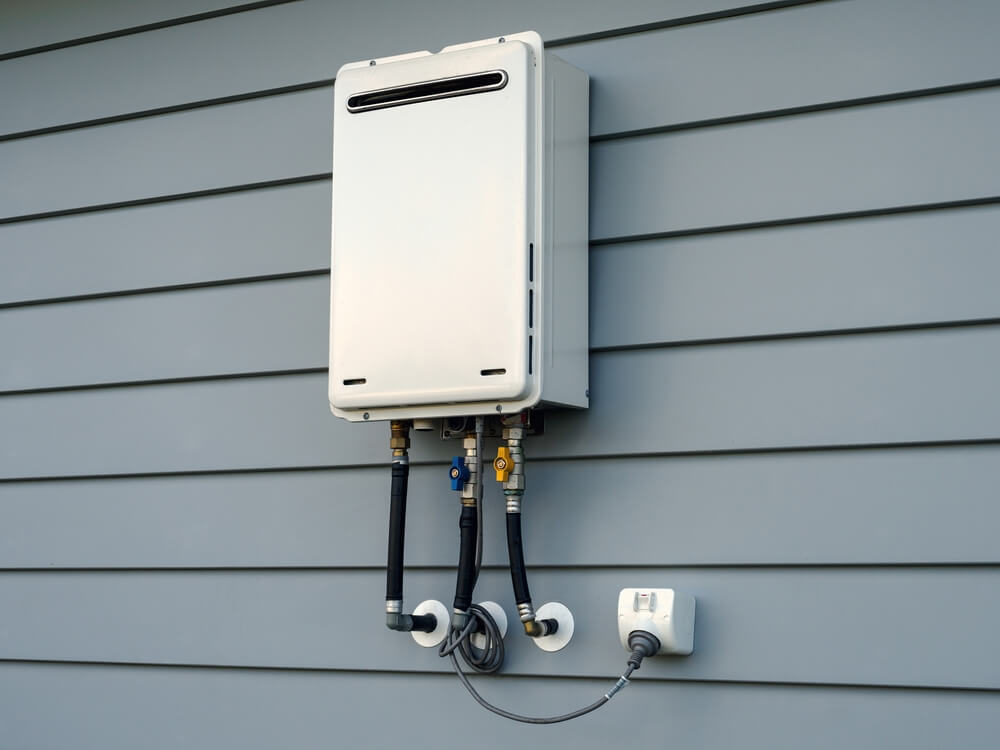
With on-demand water heaters, water is heated as it passes through the unit, eliminating the need for a ‘tank’ or reservoir of stored hot water. This setup changes how homes get hot water: the heater activates only when a tap, shower, or appliance calls for heat. The outcome is a system that trims standby heat loss and applies energy more immediately, which counts for little city dwellings as well as big homes that, in terms of space, prefer less of an imprint.
The Technology
Tankless units rely on intense electric heating elements or gas burners to warm water rapidly. As you turn on a hot tap, a flow sensor senses the activity and signals the heating element to start or the burner to ignite. Water then flows through a heat exchanger to the fixture at the set temperature. There is no hot water tank to store the hot water; heating is done on demand.
Electric models require sufficient electrical service and typically easier venting, whereas gas models need proper venting and a gas line sized to meet maximum load. Common flow rates are in the region of 2 to 5 gallons (7.6 to 15.2 liters) per minute. A single unit could easily accommodate one or two concurrent taps.
For whole-house demands, multiple units or larger commercial-grade models can be staged for higher flow and temperature-rise needs.
The Difference
Compared to tank heaters, the most obvious difference is the lack of a tank. That alters space needs: a wall-mounted tankless unit often frees up floor or closet space. Energy consumption is different. On-demand systems heat water on an as-needed basis, eliminating standby loss associated with tanks.
For homes that use 41 gallons or less per day, tankless units can be 24% to 34% more energy efficient than storage tanks. For the heavy user, about 86 gallons a day, the gain is less, roughly 8% to 14%, but still significant.
Hot water goes from a limited quantity to a never-ending stream, eliminating the chance of getting ‘showered on’ when the tank runs dry. This consistent flow is a function of unit capacity and inlet water temperature. The colder the incoming water, the more output power is required to reach setpoint, which can reduce the effective flow of hot water.
Tankless units typically last longer, often 15 to 20 years or more, which impacts lifetime cost. Energy savings typically exceed $100 annually and can reach $2,000 over 20 years, but they depend on local energy costs and usage.
The Core Debate
The core debate when deciding between tankless and storage water heaters centers around trade-offs in cost, space, performance, and long term value. Here’s a quick glance at the key advantages and disadvantages, then a targeted look at energy consumption, water availability, initial cost, durability, and size to assist you in aligning a selection with your family’s requirements.
Try doing a comparison chart with flow rates, lifespan, installation cost, and annual energy savings all side by side.
- Pros (tankless): higher energy efficiency, wall-mounted small size, extended service life (typically greater than 20 years), eliminated standby losses, instantaneous hot water, possible long-term savings.
- Cons (tankless): higher upfront price and install complexity. Limited flow rate can limit concurrent use. Might require new venting or electrical or gas supply. Very short-term payback.
- Pros (tank): lower initial cost, simple retrofit for a lot of homes, steady heat for quick spouts.
- Cons (tank): Standby energy loss. Bigger footprint. Shorter average lifespan of around 10 to 15 years. May run out of hot water during peak draw.
1. Energy Use
Tankless systems are more energy efficient, saving approximately 8% to 50% on energy bills depending on household patterns. For 41 gallons (155 liters) or less per day in the home, demand systems are 24% to 34% more efficient than storage tanks. For heavy users close to 86 gallons (326 liters) a day, savings shrink to approximately 8% to 14%.
Standby heat loss in tanks accounts for a significant portion of this gap since tankless heaters only heat water on demand. Average household energy savings may be USD 70 to 80 per year, but it compounds with a long service life. Real performance varies with household size, hot water usage, and whether the unit is gas or electric.
2. Water Supply
Tankless units supply hot water indefinitely, only up to their rated flow, which is usually 2 to 5 gallons per minute (7.6 to 15.2 liters). This can handle one or two fixtures with ease, but adding concurrent showers, a dishwasher, and a washing machine can push it over capacity and create temperature fluctuations.
Proper sizing to match peak demand is critical. Calculate combined fixture flow rates and choose a unit with headroom. Storage tanks provide high-flow bursts until the tank runs dry, then you wait.
3. Upfront Cost
Tankless systems run an average of USD 2,500 compared to about USD 1,000 for tanks. Basic storage units themselves frequently cost USD 300 to USD 600 while tankless units run about double that. Extra costs, such as venting, gas line upgrades, or increased electrical capacity, may increase the overall cost.
Budget both unit and professional installation to avoid surprises. Eventually, energy savings and longer life can compensate for the upfront spend. Payback depends on usage.
4. Lifespan
Tankless heaters last more than 20 years. Tanks last about 10 to 15 years. Tankless designs are subject to less corrosion problems and, with proper maintenance, last 15 to 20 years instead of around 10 years for most tanks.
Life is longer with added value, but upkeep and water quality play a role!
5. Space
Tankless units mount on walls and free floor space, so they’re ideal for small homes, apartments, and tight utility rooms. Flexible installation placement optimizes layouts for contemporary living spaces.
Installation Realities
Tankless water heater installation typically requires more preparation than replacing a storage tank. Plan for site, fuel source, venting, and wiring or piping evaluation, plus possible gas or electrical service upgrades. Poor installation can slash efficiency, reduce lifespan, and pose safety hazards, so include expert appraisal in the mix.
Parts on tankless units are often replaceable, which can extend service life well beyond standard figures. Many tankless units last 15 to 20 years and frequently last over 20 years, compared to roughly 10 to 15 years for tanks.
Venting
Gas tankless units create combustion gases, so they need to be vented outside. That demands a properly sized vent system, which could translate to new PVC or stainless-steel flues or even bringing an existing exhaust path up to clearance and code with upgrades.
Vent runs often require power vents or concentric pipes through walls or roofs. The longer the run and the number of roof penetrations, the more labor and materials are involved. Improper venting decreases burner efficiency, may contribute to condensation problems, and increases carbon monoxide danger.
The fact that electric tankless units don’t require combustion venting is a major reason positioning them in many homes is easier and installation is less complex. The absence of venting also makes electric models easier to site in tight spaces, although other limitations remain.
Gas Lines
Gas-fed tankless heaters often require a bigger gas feed, as burners fire at high output to heat water as it flows. Homes with small-diameter pipe or marginal gas service may necessitate re-piping or a service upgrade from the utility, contributing to both cost and permitting time.
Making sure your meter capacity and pipe sizing is taken care of before you buy eliminates surprises. A model that outpaces supply will under-deliver and short-cycle. Installation realities: A poor gas flow can lead to low flow rates, flicker or even shutdown during peak use.
Consult with a certified plumber or gas technician to confirm compatibility and obtain solid estimates for necessary upgrades.
Electrical Needs
Electric tankless units pull a boat load of amperage and virtually always need a dedicated circuit, often multiple, sometimes with an upgraded panel and heavier gauge wire in the mix. High-power models can come close to the limits of a typical household panel, so double check panel capacity prior to purchase.
Professional electrical work ensures wiring, breakers, and grounding are up to local code and that load calculations consider other household demands. If you’re considering DIY installation, check with the manufacturer first, as many warranties stipulate that a professional install is required.
For tiny homes or tiny spaces, tankless units are minimalist and work well for families who stagger hot-water demands instead of in big concurrent pulls.
- Installation requirements (gas): proper venting, larger gas line, meter capacity check, permits, qualified gas fitter, combustion air provision, condensate drain if high-efficiency unit.
- Installation requirements for electric include dedicated circuit(s), panel capacity check, heavy-gauge wiring, breakers sized to load, permits, a licensed electrician, and space and mounting considerations.
Long-Term Ownership
Long-term ownership of a tankless water heater revolves around reliability, operating costs, and what it takes to maintain efficiency for the long haul. Understanding maintenance, true lifetime cost, and ROI can help homeowners make a decision that fits their plans and local conditions.
Maintenance
Tankless units require professional servicing every year to keep mineral buildup at bay and to inspect combustion, venting, and controls. In hard water regions, an annual flushing or descaling is mandatory. Neglecting this reduces flow rate, increases power consumption, and can curtail the unit’s lifespan.

Add water softeners if your water is hard. A softener can significantly reduce scale and the need for descaling. Your service visit should include a heat-exchanger inspection, filter and inlet screen cleaning, and pressure and temperature setting verification.
A few owners supplement mid-year DIY verifications to detect leaks or error codes in between services. Great systems will provide consistent performance for 15 to 20 years or more, and some can last 25 to 30 years if parts are serviced or swapped.
Neglect cuts short life and compromises the streamline advantage that makes the higher initial cost rational. Tankless systems have serviceable components—sensors, flow valves, igniters—that can be replaced, extending usable life past the base expectancy.
Track these items in a simple log: date, service performed, parts replaced, and cost.
True Costs
Total cost of ownership combines purchase, installation, yearly maintenance, infrequent repairs, and the value of energy conserved during the unit’s lifetime. Installation differs greatly by fuel and infrastructure already in place, so estimate locally in a uniform currency.
Energy bill savings can make up for the higher initial cost in the long run, particularly in homes with a constant hot-water need. Factor in probable repair and part replacement costs, such as burner replacement, electronic board repairs, or sensor replacements, when estimating lifetime costs.
A table below contrasts lifetime costs with conservative averages over 20 years.
| Item | Tankless (20 years) | Traditional (12 years) |
|---|---|---|
| Purchase + Install | 2,500 | 1,500 |
| Maintenance & Repairs | 2,000 | 1,200 |
| Energy Costs (net) | 4,000 | 6,000 |
| Replacement cycles | 0 | 1 |
| Estimated lifetime cost | 8,500 | 9,700 |
For example, local energy rates and usage alter the outcome.
Investment Return
The average annual savings for a family of four is approximately $100, which multiplies to about $1,500 to $2,000 across a long-lived unit. Greater efficiency and long service life increase the ROI, particularly for homeowners who intend to remain in their home for several more years.
The payback period depends on actual hot-water use, energy prices, and how well you keep up on the maintenance. Consider long-term savings versus up-front costs and the potential for resale or long-term living.
Performance Factors
Tankless water heaters provide heat when needed. A number of location and system factors influence actual performance. Evaluating water quality, local climate, and correct sizing pre-purchase aids in making sure the unit fulfills daily needs, operates efficiently, and lasts.
Water Hardness
Hard water has calcium and magnesium that create scale in heat exchangers, reducing both heat transfer and flow. Scale buildup can reduce output and increase energy consumption. A unit that once provided 4 to 5 gallons per minute might slip under that threshold over time.
Place a whole-house softener or specific pretreatment for the hot-water line where heavy mineralization exists. If you have very hard water in your area, be prepared to descale regularly, anywhere from every 6 months to annually depending on hardness and usage. Manufacturers typically mandate water treatment as a warranty condition.
Neglecting hardness can void warranty coverage and reduce a tankless heater’s anticipated 15 to 20 year life span. Practical example: a family in a high-mineral area that skips softening may see efficiency drop enough that expected energy savings of 8 to 14 percent for heavy users disappear.
Climate Impact
Incoming groundwater temperature determines how much energy the unit has to add per litre. In colder climates, the unit has to increase water temperature by a greater margin. This minimizes the flow rate that can be achieved at the set temperature and decreases energy efficiency.
Seasonal variation is important. Spring and summer groundwater could permit greater flow than winter. When selecting a model, examine its rise capacity curves. These indicate flow at different inlet temperatures.
In extreme cold or large households, one high-volume unit or a whole slew of units located near points of use are required to prevent low output. For homes with steady hot water use throughout the day, demand units frequently excel. They can be 24% to 34% more efficient for low-use homes (41 gallons or less per day) and 8% to 14% more efficient for high-use homes (approximately 86 gallons), but those advantages are climate and inlet temperature dependent.
Sizing Issues
Proper sizing begins with calculating peak simultaneous demand. Add fixture flow rates for showers, dishwashers, and appliances running at once. Tankless units typically provide 2 to 5 gallons per minute, or 7.6 to 15.2 liters per minute.
Select a model whose flow at your local inlet temperature matches that peak. Undersized units cannot handle simultaneous draws, resulting in temperature fluctuations and cold shocks. Use flow-rate calculators or manufacturer charts to map model capacity to actual usage.
Factor in future modifications. Home additions, additional bathrooms, or increased occupancy can drive demand past present capacity. Tankless units win when space is tight, but tight installs still must be properly sized and vented to maintain efficiency and customer satisfaction.
My Unfiltered Take
Tankless water heaters revolutionize the way hot water is delivered and what you pay to run it. They heat water on demand rather than storing it, which shifts the trade-offs: lower energy use and less space versus higher upfront costs and some installation work. Actual owners note obvious savings in households where hot water use is consistent and heavy, but less so for low-use homes.
Tankless units can be 8% to 14% more energy efficient for homes that are high users of hot water, around 86 gallons (approximately 326 liters) per day. For smaller homes that consume 41 gallons (155 liters) or less per day, demand units can be 24% to 34% more efficient than storage tanks. This means that two households with different patterns can experience very different results.
A family taking long showers and running a couple of appliances simultaneously is when you start to see the savings. One person heating a couple liters every once in a while will see more modest gains and might not recover the elevated purchase price as quickly.
Longevity is the other obvious pro. Many tankless systems can last upwards of 20 years, with common ranges reported as 15 to 20 years and storage water heaters typically lasting 10 to 15 years. Some owners push tankless life even further by swapping out critical components like flow sensors or heat exchangers, which are typically modular and serviceable parts.
That can render total lifetime value appealing even in the face of a higher upfront cost. Performance and flow rate are important. Most tankless units provide hot water at around 2 to 5 gallons (7.6 to 15.2 liters) per minute. That’s fine for constant use in smaller configurations or where appliances are offset, but can falter if several high-demand sources run at the same time, such as two showers plus a dishwasher, unless you upsize the unit or go for multiple units.
For homes that use hot water throughout the day rather than all at once, tankless tends to feel seamless, but for large simultaneous draws it can fall short without careful planning. Initial expense and installation difficulty are legitimate issues. Tankless units are more expensive to purchase and might require upgraded gas lines, venting or electrical service.
In retrofit cases, elimination of an old tank can expose other requirements that increase the overall project expense. Maintenance differs too. Mineral buildup in hard-water areas requires periodic descaling to preserve efficiency.
Conclusion
Tankless heaters reduce energy waste and save space. They heat water on demand and can reduce utility consumption by as much as 30 percent in households with low to medium hot-water demands. They last longer than storage tanks and reduce the risk of leaks that damage floors. Initial costs are steeper. Some houses require panel upgrades or larger gas lines. Output suffers if several showers operate simultaneously. Hard water and heavy scale damage flow and heat over time.
Whether it’s a practical fit depends a lot on your household size, water use and budget. Match unit flow rate to your peak demand. Include a softener in hard-water regions. Budget for an increased initial cost and decreased annual bills.
Learn more specs and get a local quote today.
Frequently Asked Questions
What are the main advantages of a tankless water heater?
Tankless units deliver hot water on demand, minimize energy waste and occupy less room. They tend to have a longer lifespan than tank systems and, when properly sized and installed, can reduce utility bills.
What are the common disadvantages of tankless systems?
Greater initial expense and trickier installation. Flow rate restrictions may limit concurrent hot water usage. Performance can dip in very cold climates without proper sizing or preheating.
How do I know if a tankless heater fits my home?
Match peak flow requirements and incoming water temperature to the unit’s output in kilowatts or BTUs. A proper load calculation and site inspection provide the best advice.
What are typical installation challenges?
Gas line upgrades, venting, and electrical are common. Retrofitting older homes can require plumbing rework and condensate drainage. Anticipate increased upfront labor expenses.
How long do tankless water heaters last?
With proper maintenance, many last 15 to 25 years. Regular descaling and annual inspections extend life and preserve efficiency.
Are tankless heaters more energy-efficient than tanks?
Yes, for low hot water households or very high standby loss tanks. Efficiency gains vary based on usage patterns and appropriate sizing.
What maintenance does a tankless system need?
Annual descaling or flushing and a filter check are usual. Follow manufacturer instructions to keep the warranty and performance intact.